Pad Footing(V3.0)
Overview
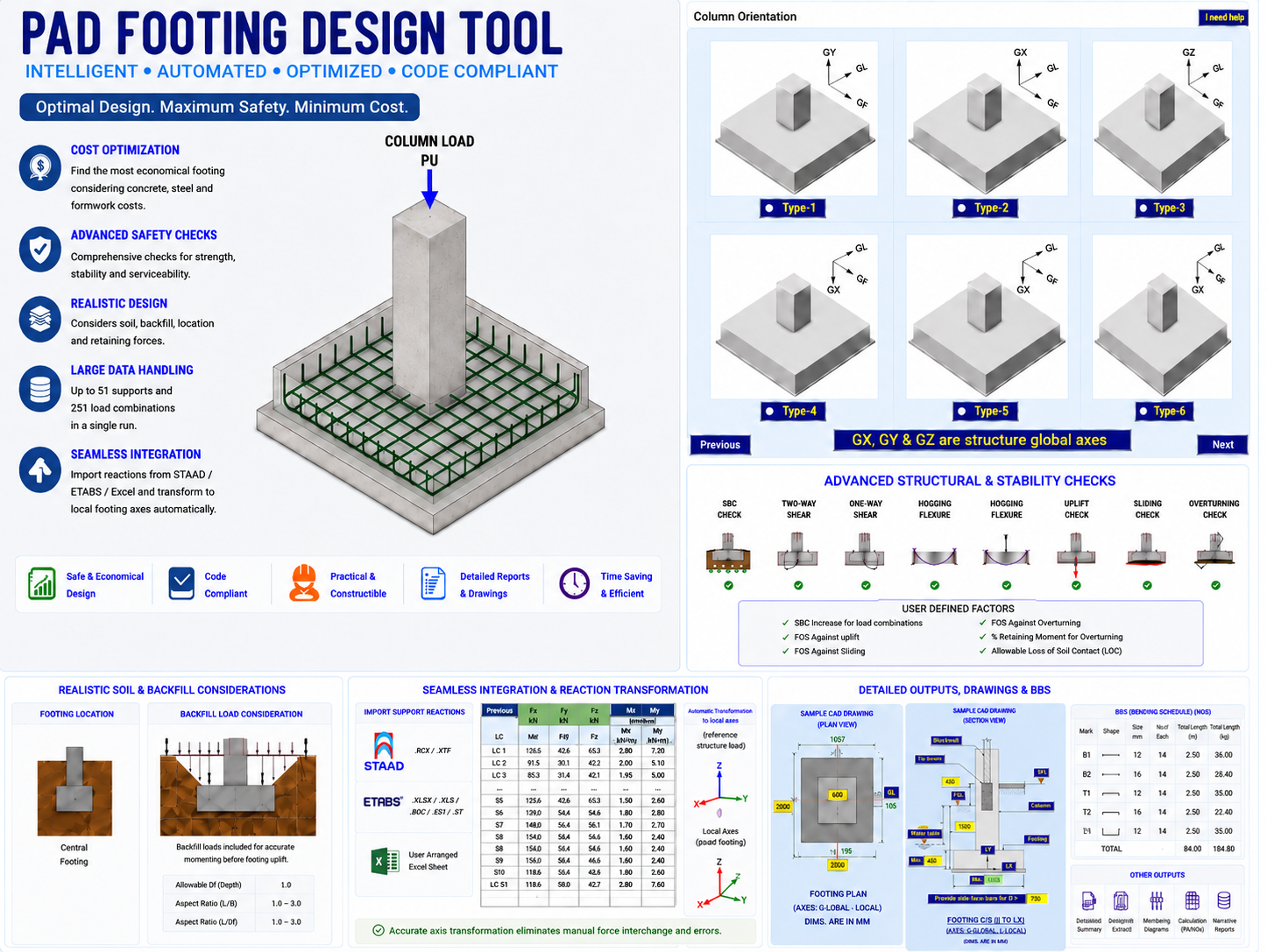
The Pad Footing Design Tool is a powerful and intelligent automated engineering solution developed for the design of reinforced concrete pad footings subjected to complex loading conditions. The software employs an advanced optimization algorithm that identifies the most cost-effective footing configuration by considering material costs for concrete, reinforcing steel, and formwork.
Designed for industrial, commercial, infrastructure, and oil & gas applications, the software minimizes manual effort, eliminates repetitive trial-and-error calculations, and delivers practical, economical, and code-compliant footing designs.
Intelligent Cost Optimization
Unlike conventional footing design spreadsheets, the software evaluates multiple feasible footing configurations and automatically determines the most economical solution based on user-defined material rates.
The optimization process considers:
- Concrete quantity
- Reinforcement quantity
- Formwork quantity
- Footing proportions
- Stability requirements
- Structural safety checks
This enables engineers to achieve highly optimized and practically constructible footing designs while significantly reducing engineering man-hours.
Advanced Structural and Stability Checks
The software performs a comprehensive set of design verifications including:
- Safe Bearing Capacity (SBC) checks
- Two-way shear checks
- One-way shear checks
- Sagging flexure checks
- Hogging flexure checks
- Uplift checks
- Sliding checks
- Overturning checks
Users may also specify:
- Load-combination-specific SBC increase values
- Factor of safety against uplift
- Factor of safety against sliding
- Factor of safety against overturning
- Percentage restoring moment contribution for overturning checks
This provides exceptional flexibility for compliance with varying project specifications and design code requirements.
Realistic Soil and Backfill Considerations
The software intelligently computes backfill loads based on the footing location, such as:
- Corner footing
- Edge footing
- Central footing
This realistic evaluation of restoring forces against uplift helps avoid unnecessary oversizing of footings.
Additionally, users may control:
- Allowable loss of soil contact (LOC)
- Footing aspect ratios (L/B, L/D, and B/D)
thereby enabling better control over footing geometry, constructability, and project-specific design preferences.
Efficient Handling of Large Design Data
The software can process:
- Up to 51 support joints
- Up to 251 load combinations in a single run
All governing load combinations are selected automatically, substantially reducing manual review effort and minimizing the possibility of missing critical loading cases.
Reactive forces may be applied at both pedestal level and footing level, offering greater flexibility for realistic foundation modeling.
Seamless STAAD and ETABS Integration
Support reactions may be imported directly from:
- STAAD analysis output files (.ANL or .TXT)
- ETABS-generated Excel and text files (.xlsx, .xls, .txt, .csv, .tsv)
- User-arranged Excel sheets
The software automatically detects supported ETABS file formats and extracts the necessary reaction data efficiently.
In addition, the software automatically transforms reactions from structural global axes to footing local axes based on the selected column orientation, eliminating the need for manual force interchange between axes.
Detailed Engineering Output
The software produces highly detailed outputs including:
- Step-by-step design calculations
- Input summaries
- Formula-based calculations
- Explanatory figures and sketches
- Design code references
- Comprehensive BOQ
- Quantity and cost estimation
- CAD drawings with rebar detailing
- Diameter-wise reinforcement quantities
The generated CAD drawings include footing layout details and reinforcement arrangements suitable for drafting and engineering documentation purposes.
Optional BBS Generation
For projects requiring fabrication-level detailing, the software can optionally generate a detailed Bar Bending Schedule (BBS) for footing reinforcement.
The BBS includes:
- Rebar shapes
- Bar dimensions
- Cut lengths
- Diameter-wise quantities
- Reinforcement summaries
This significantly improves coordination between design and construction teams.
Flexible Design Exploration
The software allows engineers to retrieve detailed calculations for any user-selected footing size from the list of successful footing options generated in the output sheets.
This feature is particularly useful for:
- Design comparison
- Client review
- Alternative design evaluation
- Value engineering exercises
The software includes numerous design options suitable for a wide range of structures and industries, making it a dependable and versatile foundation engineering solution.

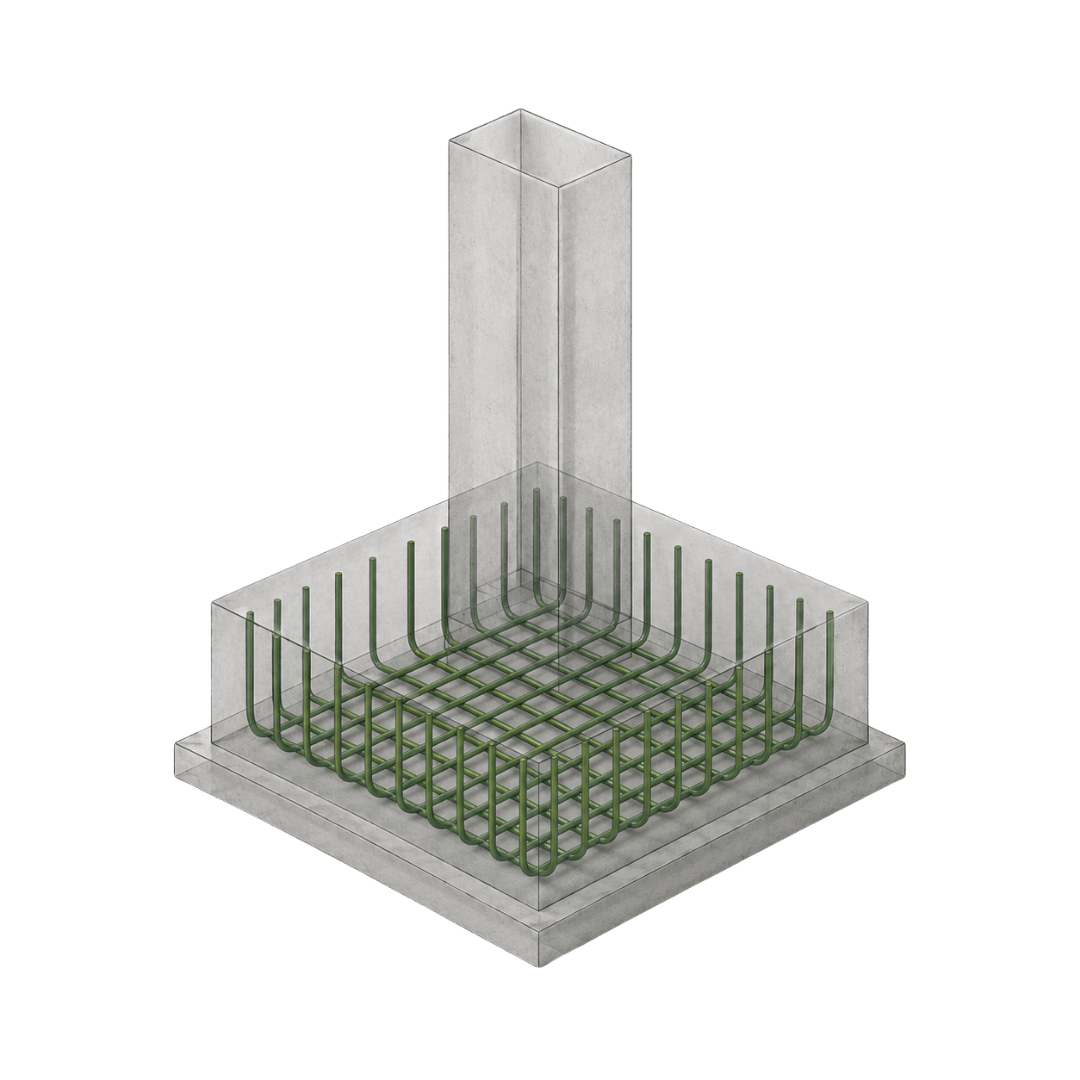
Pad Footing(V3.0)
$ 78
: 12 Months
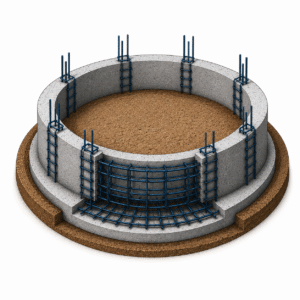
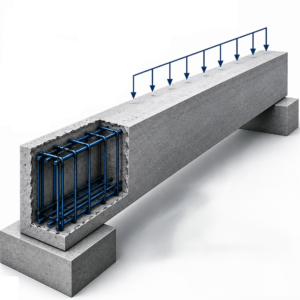
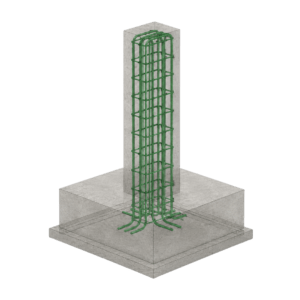
Vivek Reddy, Civil Engineer, India –
SHEETFORGE Pad Footing is a highly practical and time-saving application for foundation design. It automatically checks SBC, shear, flexure, uplift, sliding, overturning, and soil contact while also generating BOQ, BBS, and CAD drawings.
Ethan Walker, Project Engineer, USA –
The AI-driven optimization in SHEETFORGE Pad Footing helped us arrive at economical footing sizes by considering concrete, steel, and formwork quantities. It is a very useful tool for fast and cost-effective foundation design.
Mohammed Farooq, Senior Structural Engineer, Qatar –
his application has greatly reduced our design and drafting effort. With automatic load combination selection, STAAD/ETABS import, detailed calculations, BOQ, BBS, and CAD output, SHEETFORGE Pad Footing is a complete design solution.